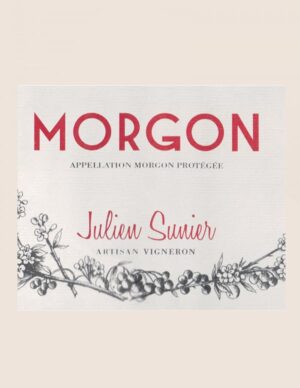

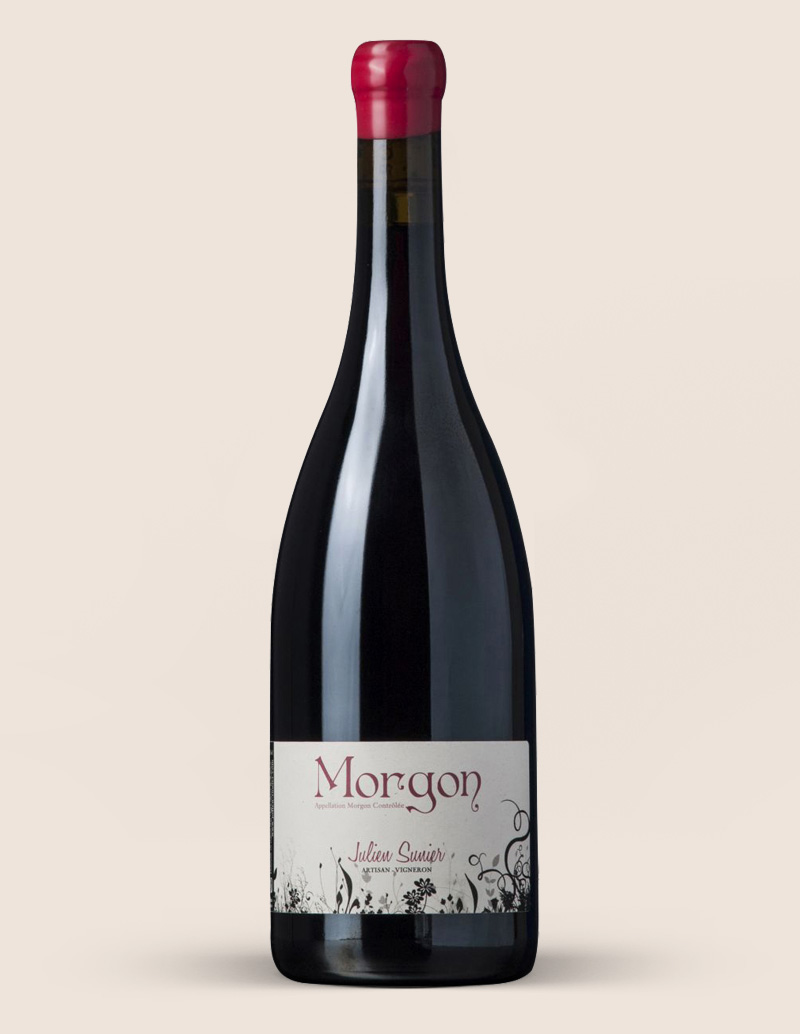
Julien Sunier Morgon Cru Beaujolais Magnum 2017
$152.00 inc. GST
AROMA: Generous and fleshy Morgon offering notes of black cherries and spices.
PALATE: Beautiful silky tannins
FOOD MATCH: Patés & terrines.
Grape Variety: Gamay
Drinking window: 2025-2030+
Alc. 12,50%

15 in stock
Description
Julien Sunier has gone from being rising star to firmly established as one of the best producers in Beaujolais. Following in the footsteps of pioneers like his friends Marcel Lapierre and Jean-Paul Thévenet he works organically and biodynamically in the vineyard and naturally in the winery. Julien now has 7.5 hectares of organically farmed vines in Regnié, Fleurie and Morgon. When I first visited him in 2016, he emphasised how hard it is to work organically in Beaujolais, and just how back breaking the work can be. ‘We have opportunities to rent because people are getting old,’ says Julien, who talks much more than his younger brother. ‘Young people are beginning to arrive in Beaujolais. It’s pretty trendy and we have a good group of natural winemakers, but when you see the size of the vineyard, we need the young generation to come here.’
He says that organics is rare in Beaujolais because the vineyards are difficult to manage. The issue is manual weed control with the densely planted bush vines. ‘We are very proud to farm organically,’ he says. ‘It is almost double the cost in the vineyard but our price isn’t twice as much. In his small winery he works semi-carbonically (starting off fermentation carbonically but later pumping over and plunging as you would do in Burgundy), believing that full carbonic can risk losing the terroir. He only adds sulfur dioxide at bottling. Julien’s wines are really elegant and expressive. They have purity and express their terroirs really well.
1500ml bottle. (Must be ordered in quantities of 6)
The grapes, from old vines, come from six different very complementary parcels on the climates “Charmes, Corcelette, Py,” located between 270 and 420 m altitude.
Vineyard: Two parcels; one on the sloped lieu-dit of Corcelette and the other at the edge of the Morgon/Régnié border in a vineyard named En Oeillat. Both parcels were planted in the 1960s. Both are densely planted.
Orientation: Southwest facing.
Soil: Decomposing granitic topsoil, referred to locally as roche pourrie or rotted rock, over clay base 2 meters below.
Viticulture: Organic farming, harvesting done entirely by hand.
Vinification: Indigenous yeast fermentations in concrete vats at low temperatures, to preserve fresh fruit flavors and a delicate tannic structure. After fermentations are complete, fruit is slowly pressed, over a 24 hour period, using an ancient vertical press Julien acquired in the Côte D’Or.
Ageing: Aged for up to 11 months in 3 – 9 year old Burgundy barrels so the charming fruit and granitic soil avors aren’t lost.
Additional Information
| size | |
|---|---|
| brand |
Tech Sheets
Reviews / Awards / Ratings
THE Winefront
Julien Sunier Morgon Cru Beaujolais 2017 – 95 / 100 Points
From a selection of vineyards in Morgon (Vermont 0.4, Py 0.4, Aux perrets 0.25,Croix de chèvre 0.43, etc.) with an average vine age of 60 years. Dried roses, dark cherry, cinnamon and sweet earth. Fleshy supple tannin, mouth-perfume and ripe cherry flavour, depth and length, the finish is particularly impressive. Unforced and beautiful.
– Gary Walsh
Robert Parker
Julien Sunier Morgon Cru Beaujolais 2017 – 92 / 100 Points
“The 2017 Morgon had just been bottled when I tasted it last year, and it’s performing much better today, revealing a complex bouquet of ripe cherries, dark chocolate, smoked meats, peonies and spices. On the palate, it’s medium to full-bodied, layered and velvety, with excellent depth and concentration, concluding with a sapid—indeed carnal—nish.”
– Robert Parker
Jancis Robinson
Julien Sunier Morgon Cru Beaujolais 2017 – 17+ / 20 Points
“2 ha (5 acres) in six different parcels, e.g. Aux Charmes in the west and Corcelette in the north of the cru. Mainly old bush vines – some need replanting. More expressive than the Régnié at the moment. Darker, riper fruit aroma – more fruity. More juice in the berries from these sites. Same dry finesse in the texture but more rounded and more juicy. There’s a darkness to the fruit that is very elegant. The tannins are dry but supple. Cool, long and savoury. The overwhelming character is still that stony/mineral quality. Long and fresh, but so beautifully paper-dry. Opens to more fruit.”
– Jancis Robinson
You may also like…
-
Julien Sunier Régnié Cru Beaujolais 2018
$75.00 inc. GST -

Julien Sunier Morgon Cru Beaujolais 2021
$85.00 inc. GST -
Julien Sunier Morgon Cru Beaujolais Tasting Selection (6 x Bottles)
Original price was: $498.00.$426.00Current price is: $426.00. inc. GST -
Julien Sunier Morgon Cru Beaujolais 2022
$89.00 inc. GST